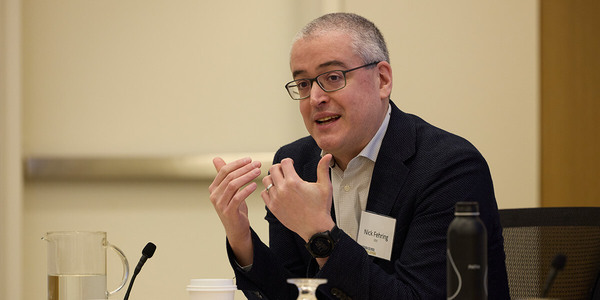
“We all have material gaps in our understanding,” said Nick Fehring, vice president and controller of IBM, “and those gaps are best filled when we come together to have fulsome conversation.”
With these words, Fehring, who serves on the steering committee of the Notre Dame-IBM Technology Ethics Lab, opened his panel presentation at last week’s AI & Labor Policy Workshop in Washington, DC. The daylong workshop fulfilled Fehring's vision of "fulsome conversion," bringing together academics, business leaders, and policy makers from across the country to explore the impact of AI on the national workforce and to inform effective policies and recommendations.
The workshop was presented by Notre Dame’s Keough School of Global Affairs and by the University’s Institute for Ethics and the Common Good, part of the Notre Dame Ethics Initiative, in partnership with the Keough School’s McKenna Center for Human Development and Global Business and the institute’s Notre Dame-IBM Tech Ethics Lab.
Fehring went on to explain that up to $3.5 trillion of economic growth could be realized in the next five to 10 years if public and private organizations are able to effectively harness the power of AI—“but you need to have your house in order,” he added. Any organization looking to make strides in the effective adoption of AI, Fehring emphasized, needs to be very deliberate in aligning its people, processes, and data.
What skills will be most valuable for individual workers in the new AI economy? Ultimately, Fehring called for an "engineering skill set" as the most useful foundation for the workforce as AI becomes increasingly pervasive.
“The focus is not so much on technical skills,” said Fehring. “There’s an attainment of those skills, yes. But this is really more about problem solving, analytical ability, resourcefulness.”
The Tech Ethics Lab—a critical component of Notre Dame's Institute for Ethics and the Common Good—creates unique opportunities for researchers and students to develop precisely these skills, benefitting from Notre Dame's long-term relationship with one of the world's leading technology companies, IBM. These opportunities include the new Tech Ethics Lab Program Chairs, which support the research of three Notre Dame faculty with funding over a three-year period, as well as a renewed graduate fellowship program. The Tech Ethics Lab Graduate Fellowship gives Notre Dame PhD candidates a yearlong academic experience that advances their scholarly and professional development within the context of a supportive, interdisciplinary community. A signature mark of the fellowship will be a fully-funded externship embedded in a technology company, allowing these fellows to work alongside engineers and developers to experience the industry landscape firsthand.
Through convenings such as the AI & Labor Policy Workshop, the Tech Ethics Lab works to stimulate essential dialogue, influence guidelines and practices for responsible innovation, and continue to build bridges between public and private interests.
The AI & Labor Policy Workshop was organized by Yong Suk Lee, associate professor of technology, economy and global affairs in the Keough School of Global Affairs and program chair for technology ethics in the Institute for Ethics and the Common Good.
__________
The Notre Dame–IBM Technology Ethics Lab, a critical component of the Institute for Ethics and the Common Good and the Notre Dame Ethics Initiative, promotes interdisciplinary research and policy leadership in technology ethics and is supported by a $20-million investment from IBM.