


We convene a multidisciplinary community to develop compelling responses to the most pressing ethical issues of our era.

Born out of hundreds of conversations and focus groups with theologians, technologists, faith leaders, students, educators, and parents, DELTA brings the deep tradition of Christian virtue ethics into direct conversation with industry leaders and the global public. We provide spaces for real, honest, and sometimes messy conversations about who we are becoming in this time of technological disruption.
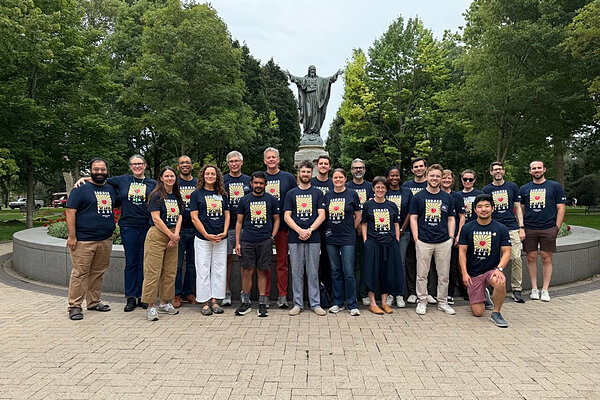
The Love Ethic is a way of being. Everyone is worthy of love, because every human has dignity. Love is the foundation of our moral and social lives. We are thus called to love our neighbors, strangers and even our enemies – everyone.

Promoting broad-based, far-reaching interdisciplinary research, thought, and policy leadership in artificial intelligence and other technology ethics by engaging with relevant stakeholders to examine real-world challenges and provide practical models and applied solutions for ethical technology design, development, and deployment.
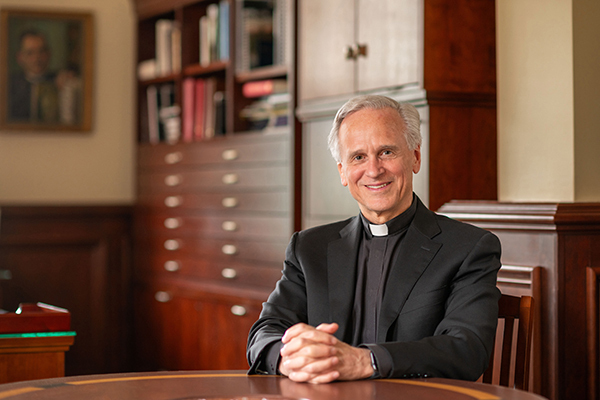
Supporting preeminent scholars whose research advances human flourishing in both moral and spiritual contexts, facilitating the development of undergraduate courses exploring topics such as justice and the common good, and deepening the ethical formation of Notre Dame students and faculty.
This changing world will confront humankind with enormous new moral problems of unprecedented proportion and consequences … it will take a very special kind of university to direct change in such a way that humans do not destroy themselves and their world … It is this kind of institution that Notre Dame aspires to be.
—Rev. Theodore M. Hesburgh, C.S.C.
Notre Dame is one of the most trusted universities in the United States. No institution is better positioned to foster reasoned, constructive conversations rooted in the Catholic ideals of respect for human dignity and the unity of knowledge, and guided by the rational ideals of adherence to evidence and consistency in argumentation. And no institution is better positioned to develop students who approach the world with openness, with curiosity, with compassion, and with moral courage.
—Rev. Robert Dowd, C.S.C.
Virtue ethics tells us that the moral life is not simply about discrete actions properly performed, nor about achieving laudable results in the world, but about becoming a certain kind of person.
—Rev. John I. Jenkins, C.S.C.


Forbes
September 29, 2026
A new white paper from All Tech is Human and the Notre Dame-IBM Technology Ethics lab, Two Views of the Same Transformation, heard the same story from below. Mid-level professionals said checking AI output is a growing, unrecognized share of their work, and some called it “babysitting AI slop.” The glue work of a rollout is missing from performance reviews, and women reported carrying more of it. Executives, meanwhile, described middle management as a layer to cut, then worried about “distributed deskilling.”
September 03, 2026
Meghan Sullivan, a Catholic philosopher at the University of Notre Dame who often meets with AI leaders and developers, said many workers in the industry “talk very flippantly” about job displacement and AI being able to do work faster and cheaper. Some are trying to transcend work and get to a place where they devote all their time to family and hobbies, like gardening and crafts.